
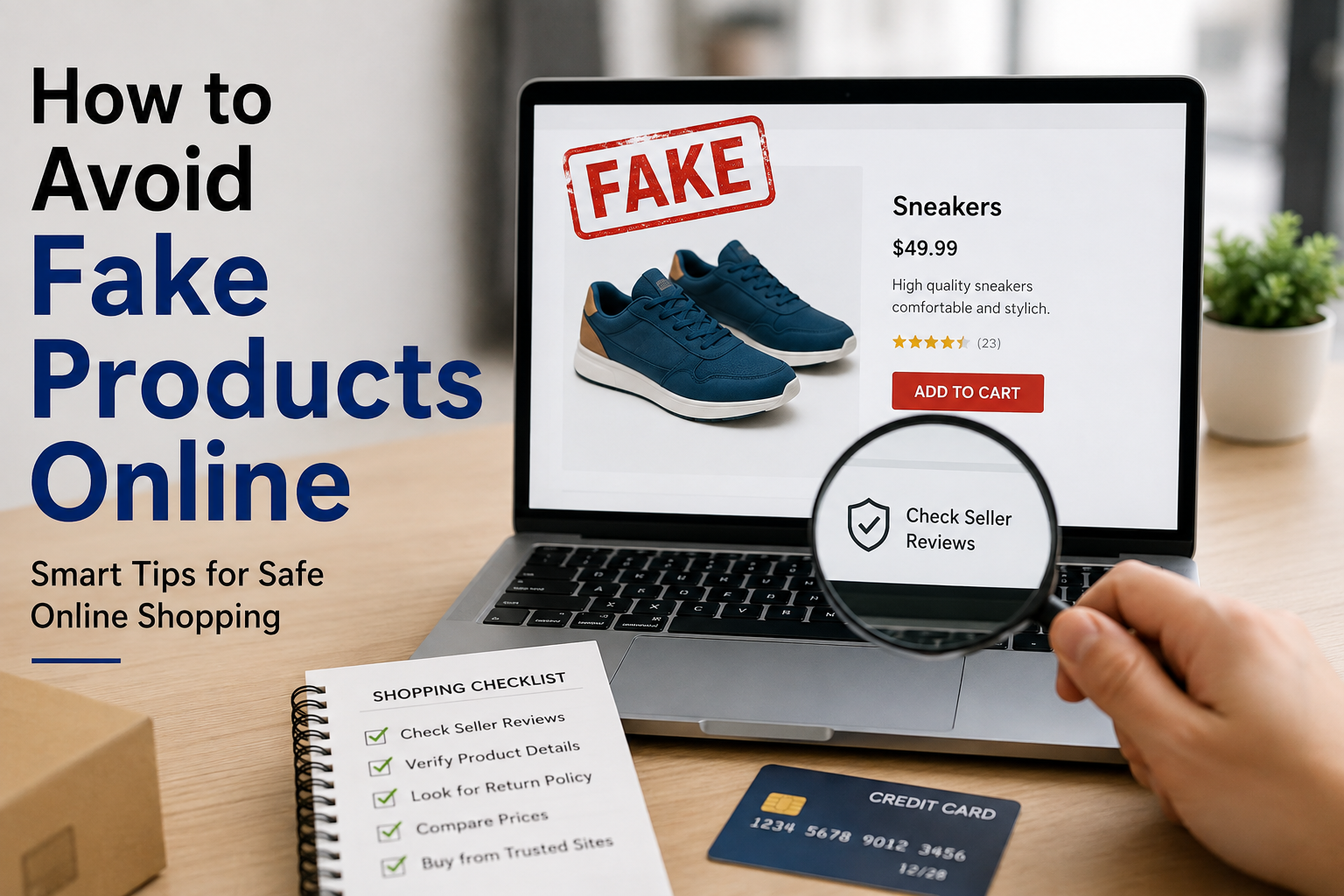
Online shopping has made life much easier for me. I can search for almost anything, compare prices, read reviews, and place an order without leaving my home. At the same time, I have learned that online shopping also requires some careful thinking. One of the biggest problems shoppers can face is buying a fake product without realizing it.
Fake products can look surprisingly similar to genuine products. Some sellers use professional pictures, attractive descriptions, and even copied customer reviews to make their products appear trustworthy. This is why I believe that knowing how to identify suspicious products is just as important as finding a good price.
In this article, I want to share some simple things I personally consider before buying products online. These tips can help beginners shop more confidently and reduce the chances of wasting money on counterfeit or poor quality items.
Check the Seller Carefully
The first thing I look at before buying something is the seller. I do not simply look at the product because the same product can be offered by many different sellers.
I check the seller’s rating, number of completed orders, customer feedback, and how long the seller has been active. If a seller has very few reviews or many complaints about product quality, I become more cautious.
I also read recent reviews instead of depending only on the overall rating. A seller may have thousands of positive ratings, but recent customers could be reporting problems. Looking at current feedback gives me a better idea of what the seller is offering today.
Compare the Price With Other Sellers
A very low price can be tempting, especially when I see a product that normally costs much more. However, an unusually cheap price is one of the signs that makes me stop and investigate further.
For example, if several reliable sellers are offering a branded product for around $100 and one unknown seller is offering exactly the same item for $25, I would not immediately assume that I found an amazing deal.
There could be a legitimate reason for the lower price, such as a clearance sale or an older model. But there is also a possibility that the product is fake, damaged, used, or completely different from the advertised item.
I believe comparing prices across several trusted stores is one of the easiest ways to recognize suspicious deals.
Look at Product Photos Carefully
Product photos can tell me a lot. When I am considering an expensive product, I look closely at the pictures instead of quickly clicking the buy button.
Sometimes fake sellers use official pictures taken directly from the manufacturer’s website. This means the picture itself may look completely genuine even though the seller is not offering an authentic product.
I also look for multiple product photos. Genuine sellers often provide pictures from different angles and show packaging, labels, model numbers, or other useful details.
If the listing has only one generic image, I become more careful. I may also search for pictures of the genuine product on the manufacturer’s official website and compare the details.
Read Customer Reviews
Customer reviews are another useful source of information. I usually read both positive and negative reviews because they can reveal things that are not obvious from the product description.
I pay attention to comments about packaging, materials, quality, color, size, serial numbers, and differences between the advertised product and the item received.
Photos uploaded by customers can be especially helpful. They show what people actually received instead of what the seller wants shoppers to see.
I also avoid trusting reviews that sound almost identical or extremely general. A large number of short comments saying only that the product is great does not always provide enough information.
Check the Product Description
I never ignore the product description. Sometimes suspicious listings contain strange wording, spelling mistakes, missing specifications, or information that does not match the manufacturer’s details.
I compare important specifications with information from the official brand website. This can include product dimensions, model numbers, materials, colors, included accessories, and compatibility.
If the listing says one thing while the manufacturer’s website says something completely different, I would rather avoid the purchase.
Buy From Trusted Websites
Where I buy something matters almost as much as what I buy. I generally feel more comfortable using established online stores or official brand websites.
Large marketplaces can also have third party sellers, so I do not automatically assume that every product sold through a popular marketplace is genuine.
For expensive electronics, branded clothing, beauty products, accessories, and other commonly copied items, I prefer checking whether the manufacturer has an official online store or a list of authorized sellers.
This extra step can take a few minutes, but I think it is worth the time when a purchase involves a significant amount of money.
Look for Authenticity Information
Some brands provide ways for customers to verify products. Depending on the product, this may include a serial number, authentication code, QR code, security label, or registration system.
If a product has an identification number, I check whether it can be verified through the manufacturer’s official website.
However, I do not assume that every code proves a product is genuine. Counterfeit sellers sometimes copy codes from real products or create fake verification pages. That is why I prefer entering information directly through the official manufacturer’s website rather than following a random link provided by a seller.
Be Careful With Social Media Deals
Social media has become a popular place to discover products. I have seen many attractive advertisements offering branded products at huge discounts.
The problem is that not every social media advertisement leads to a trustworthy store. Some pages may disappear after collecting payments, while others may send products that are very different from what was advertised.
Before purchasing through a social media advertisement, I check the website, seller information, customer reviews, return policy, and contact details.
If a page has been created recently and offers expensive products at unbelievable prices, I take that as a warning sign.
Check the Website Before Paying
A professional looking website does not automatically mean that the store is legitimate. Fake stores can be designed to look surprisingly convincing.
Before entering payment information, I check whether the website clearly provides contact information, shipping details, return policies, and terms of service.
I also check the website address carefully. A fake website may use a domain name that looks similar to a famous brand but contains extra words, unusual spelling, or small changes.
I never rush through the checkout process simply because a countdown timer says an offer will disappear soon. Pressure is often used to make shoppers stop thinking carefully.
Understand the Return Policy
A clear return policy gives me more confidence when shopping online. Before buying, I check whether the seller allows returns and what conditions apply.
I also look for information about refunds, damaged products, incorrect products, and return shipping.
If a seller refuses to explain what happens when the product is not as advertised, I consider that a reason to look elsewhere.
A good return policy cannot guarantee that a product is genuine, but it can provide some protection if something goes wrong.
Use Safe Payment Methods
I prefer payment methods that provide some level of buyer protection. Depending on the website and country, this could include a credit card or a trusted payment service.
I avoid sending money through unusual payment methods simply because a seller says it is required to receive a discount.
I also avoid sharing unnecessary personal information. An online store normally does not need sensitive information that is unrelated to completing the purchase.
After making a payment, I keep the order confirmation, receipt, and important communication with the seller. These records can be useful if there is a dispute later.
Do Not Trust Every Discount
One of the biggest lessons I have learned from online shopping is that a discount does not automatically mean a good deal.
Some sellers increase the original price and then advertise a large discount. Others use extremely low prices to attract customers.
Before getting excited about a sale, I compare the price with other stores and check whether the product is actually the same model.
I also ask myself whether the deal makes logical sense. If something normally costs several hundred dollars and suddenly appears for a tiny fraction of the normal price, I investigate before buying.
Search for the Product Outside the Store
Another simple habit I find useful is searching for the product independently.
If I find an item on an unfamiliar website, I search for the product name along with words such as reviews, complaints, counterfeit, or customer experiences.
This can reveal information that is not visible on the seller’s website.
I also search for the exact model number. Sometimes this helps me discover that the product is an older model, a different version, or something that does not actually match the seller’s description.
Trust Your Instincts
Sometimes a product listing simply feels wrong. Maybe the price is too low, the seller has strange reviews, the website looks incomplete, or the description does not make sense.
When I notice several warning signs at the same time, I do not try to convince myself that everything will be fine.
There are usually many other sellers online. Walking away from one suspicious deal is better than losing money and receiving a fake product.
What to Do If You Receive a Fake Product
If I ever receive a product that appears counterfeit, I would avoid using it until I know what it actually is. This is particularly important with products that can affect safety or health.
I would take clear photographs of the product, packaging, labels, receipt, and shipping information. I would then contact the seller and use the platform’s official dispute or return process if necessary.
If I paid through a method that provides buyer protection, I would follow its dispute procedure.
I would also consider leaving an honest review based on my actual experience. This can help other shoppers avoid the same problem.
Final Thoughts
For me, safe online shopping is mostly about slowing down and paying attention. Fake products can be difficult to identify because counterfeit sellers have become better at creating convincing listings.
The good news is that shoppers can reduce the risk by taking a few simple steps. Check the seller, compare prices, read customer reviews, inspect product photos, verify important product details, research unfamiliar websites, understand the return policy, and use safer payment methods.
Most importantly, I never let an exciting discount pressure me into making a quick decision. If a deal looks too good to be true, I take some time to investigate it.
Online shopping should be convenient and enjoyable, but being careful is part of being a smart shopper. A few extra minutes of research can save money, frustration, and disappointment later.
