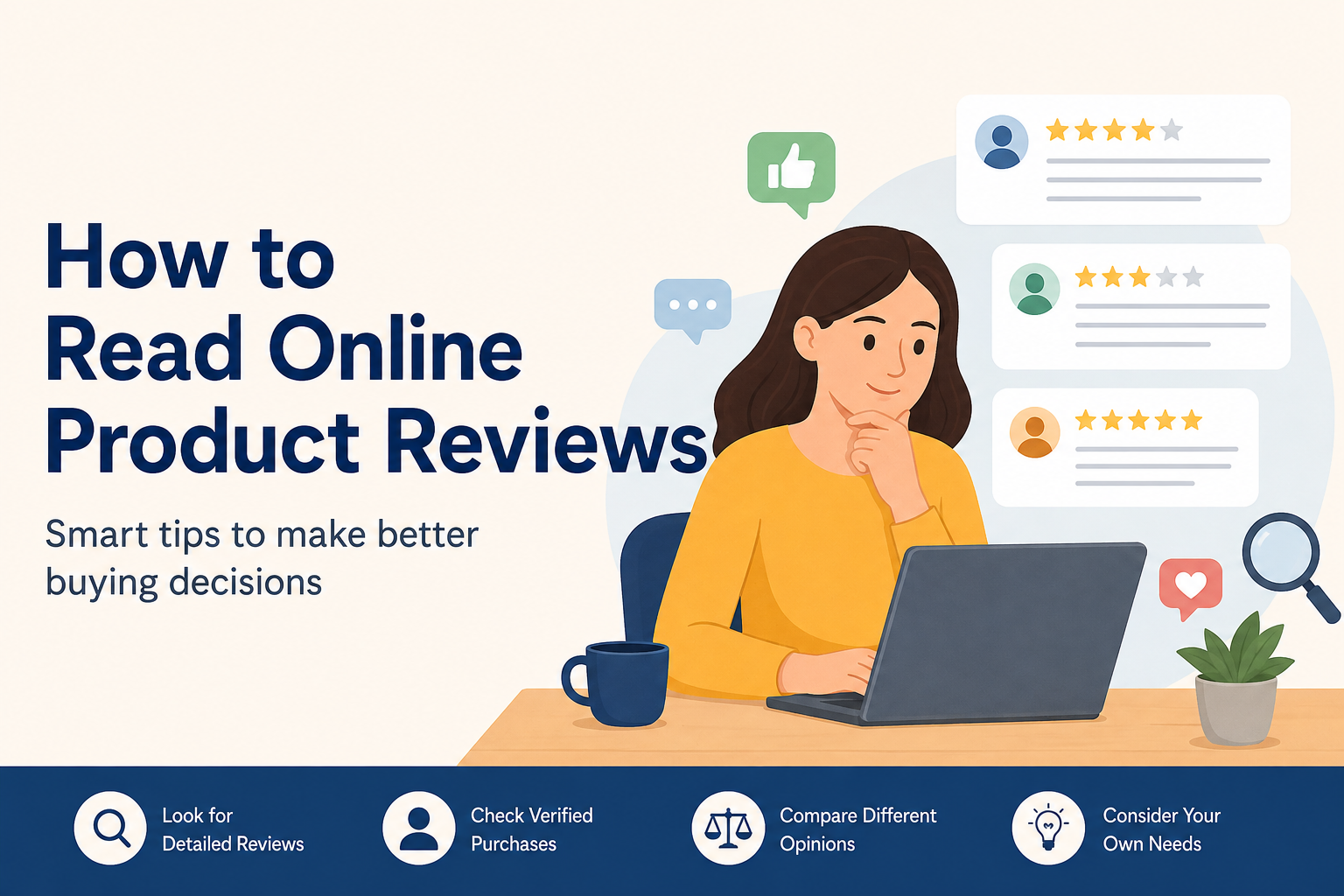
When I want to buy something online, one of the first things I do is read product reviews. I have learned that reviews can be extremely helpful, but only when I know how to read them properly. A product may have thousands of positive ratings, but that does not always mean it is the right choice for me. At the same time, a few negative reviews do not necessarily mean the product is bad.
Online reviews give us an idea about other people’s experiences. They can tell us what works well, what problems people have faced, and whether a product is worth considering. However, reviews can also be confusing because everyone has different expectations. In my opinion, the best approach is not to look at one review and immediately make a decision. Instead, I like to compare different opinions and look for useful details.
Why Online Product Reviews Matter
Online shopping has made buying products much easier. We can compare prices, features, brands, and customer opinions without visiting several physical stores. However, there is one major disadvantage. We cannot usually touch, test, or personally inspect a product before buying it.
This is where reviews become useful.
A review can provide information that may not be obvious from a product description. For example, a seller might mention that a pair of shoes is comfortable, but customers may explain whether the shoes actually remain comfortable after several hours of use.
I find this type of information particularly valuable because real users often discuss practical experiences that product descriptions do not cover.
Do Not Look Only at the Star Rating
One of the biggest mistakes I see people make is looking at the star rating and stopping there.
If a product has a 4.7 star rating, it may look excellent. However, that number does not explain why people gave those ratings. I always prefer to read some actual reviews before making a decision.
A high rating can hide important information. Perhaps most customers are happy with the product, but some people have reported a problem that matters to me. If I only look at the overall rating, I may miss that information.
I also avoid judging a product only because it has a few low ratings. People sometimes give a product a poor rating because of an issue that would not affect my particular needs.
The rating is useful as a starting point, but the written review is where I usually find the real information.
Read Both Positive and Negative Reviews
I believe a balanced approach is important when reading reviews.
Positive reviews can tell me what people like about a product. They may mention good quality, useful features, comfortable design, easy setup, or good performance.
Negative reviews can reveal potential weaknesses. They may mention poor durability, confusing instructions, uncomfortable design, disappointing performance, or problems with customer service.
I do not automatically believe either side. Instead, I look for patterns.
If one person says that a product stopped working after a week, that could simply be an individual experience. But if many customers report the same problem, I take it much more seriously.
This is one of the simplest ways I use reviews to make better buying decisions.
Look for Detailed Reviews
Not every review provides useful information.
A review that simply says “Great product” does not tell me very much. I prefer reviews that explain what the customer liked or disliked and why.
For example, a detailed review might explain how long the product was used, what features worked well, what problems appeared, and whether the customer would buy it again.
These reviews are much more helpful because they provide context.
When I read a detailed review, I also try to understand whether the reviewer has similar needs to mine. Someone who uses a product occasionally may have a completely different experience from someone who uses it every day.
Pay Attention to Verified Purchases
If a shopping website identifies a review as coming from a verified purchaser, I usually give it more attention.
A verified purchase label can indicate that the reviewer actually bought the product through the platform. It does not automatically mean the review is perfect or completely unbiased, but it gives me another useful piece of information.
I still read the content of the review rather than trusting the label alone.
The most useful reviews usually combine personal experience with specific details.
Check the Date of the Review
Another thing I consider is when the review was written.
Products can change over time. A manufacturer may update the design, improve materials, change packaging, or release a newer version.
A review written several years ago may not accurately describe the current version of a product.
This is especially important for technology products. Software updates, new models, and revised hardware can change the user experience.
When possible, I give more attention to recent reviews while still checking older reviews for long term information.
Look for Common Problems
One negative review does not always concern me. Repeated complaints do.
If I notice that many customers mention the same problem, I consider it a warning sign. For example, several customers may report that a product breaks easily, has poor battery life, or does not match its description.
Repeated comments are more meaningful because they suggest that the issue may not be an isolated incident.
I also look at how serious the problem is. A small inconvenience may not matter to me, while a safety issue or major quality problem could completely change my decision.
Understand That Everyone Has Different Expectations
This is one of the most important lessons I have learned from reading online reviews.
People buy products for different reasons.
A person may give a laptop a negative review because it is not powerful enough for professional work. Another person may give the same laptop five stars because it works perfectly for browsing and studying.
Neither person is necessarily wrong.
Their expectations are simply different.
Before judging a review, I ask myself whether the reviewer wanted the same things that I want. This helps me avoid making decisions based on experiences that are not relevant to my situation.
Be Careful With Extremely Positive Reviews
Extremely positive reviews can be useful, but I do not automatically trust them.
If a review contains very general language and gives no practical details, I do not find it particularly helpful. I prefer natural reviews that explain how the product was actually used.
I also look for consistency. If many reviews seem to use nearly identical wording, I become more cautious.
The goal is not to assume that every positive review is fake. It is simply to avoid making a purchase based on a few overly enthusiastic comments.
Be Careful With Extremely Negative Reviews
The same principle applies to negative reviews.
Sometimes people leave a very low rating because of a problem with delivery, packaging, or something unrelated to the actual product.
For example, if someone complains that a package arrived late, that may tell me more about the delivery experience than the quality of the product itself.
I separate product related complaints from seller or shipping complaints whenever possible.
This helps me understand what I am actually buying.
Compare Reviews From Different Websites
When a product is expensive or important, I like to check more than one source.
Different websites may have different groups of customers. One platform may have hundreds of reviews while another may provide expert testing or longer customer experiences.
Comparing different sources can help me identify common strengths and weaknesses.
If several independent sources mention the same advantage or problem, I pay closer attention to it.
Read Reviews About the Specific Version
Another useful habit is checking whether the review is actually about the same version of the product.
Some products have several sizes, colors, models, storage capacities, or generations.
A review for an older version may not apply to the newer one.
Before relying on a review, I check the product details and make sure the review matches the version I am considering.
Look at Photos When Available
Customer photos can sometimes tell me things that official product pictures do not.
Photos may show the actual size, color, packaging, material, or appearance of a product in normal surroundings.
I find customer photos especially helpful for clothing, furniture, home accessories, bags, and other physical products where appearance matters.
However, lighting and camera quality can affect how a product looks, so I do not treat every photo as an exact representation.
Think About Your Own Needs
At the end of the day, reviews are there to help me make a decision, not to make the decision for me.
I always try to connect what I read with my own needs.
I ask questions such as whether the product fits my budget, whether the features are useful to me, whether the reported problems would bother me, and whether the product is suitable for the way I plan to use it.
A product with thousands of positive reviews can still be the wrong product for me.
The best product is not necessarily the one with the highest rating. It is the one that matches my requirements.
Do Not Rush Your Decision
I have found that rushing is one of the easiest ways to make a poor online purchase.
When I see a product with a good price and attractive reviews, it can be tempting to buy immediately. However, spending a few extra minutes reading carefully can save money and frustration later.
For expensive purchases, I take even more time. I compare alternatives, read positive and negative reviews, check recent feedback, and consider whether I actually need the product.
This simple habit has helped me become a more careful online shopper.
Final Thoughts
Learning how to read online product reviews is an important part of smart online shopping. Reviews can provide valuable information, but they need to be understood in the right way.
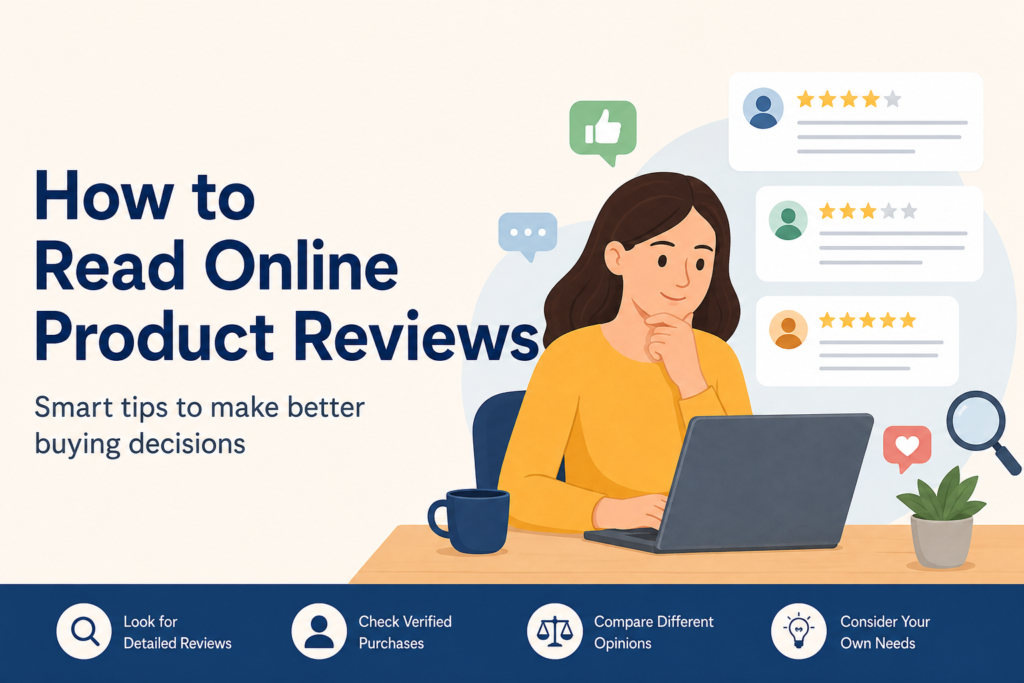
I do not rely only on star ratings. I read detailed reviews, compare positive and negative experiences, check recent feedback, look for repeated problems, and consider whether the reviewer has needs similar to mine.
I also try not to let one extremely positive or negative opinion control my decision.
For me, the best approach is to look for patterns rather than individual comments. When several customers independently describe the same experience, that information becomes much more useful.
Online reviews cannot guarantee that every purchase will be perfect, but they can reduce uncertainty and help us make more informed choices. With a little patience and careful reading, I believe anyone can become better at understanding product reviews and shopping with greater confidence.