When I want to buy a new product, I usually do not make my decision after looking at one advertisement or reading one review. There are simply too many products available today, and every seller claims that their product is the best. This can make choosing the right product confusing, especially when I am spending a significant amount of money.
Over time, I have learned that finding reliable product recommendations is less about finding someone who tells me what to buy and more about learning how to research products properly. A good recommendation should help me understand the benefits, limitations, quality, price, and real world performance of a product.
In this article, I will share the approach I personally find useful when looking for trustworthy product recommendations.
Start by Understanding What You Actually Need
Before searching for recommendations, I think it is important to understand my own needs. A product that works perfectly for one person may not be suitable for another person.
For example, if I am looking for a laptop, I first consider what I will use it for. If I only need it for browsing, writing, and watching videos, I may not need an expensive high performance laptop. If I want to edit videos or play demanding games, my requirements will be completely different.
I recommend making a simple list of the features that matter most to you. Think about your budget, preferred size, important features, expected usage, and how frequently you will use the product.
This simple step can prevent me from being influenced by features that sound impressive but are not actually useful for my situation.
Look at Multiple Sources
One of the biggest mistakes I try to avoid is relying on a single recommendation. Even if the person giving the recommendation appears knowledgeable, their experience may not represent everyone’s experience.
I prefer to compare information from several independent sources. These can include professional reviews, customer reviews, discussion forums, comparison websites, and product documentation.
When several sources mention the same strengths or weaknesses, I pay more attention to those points. If one review says something completely different from everyone else, I investigate further before making a decision.
Looking at multiple sources gives me a broader understanding of the product and reduces the chance of making a decision based on incomplete information.
Read Detailed Reviews Instead of Only Star Ratings
Star ratings are useful, but I do not think they tell the whole story. A product with a high rating can still have problems that matter to me.
For example, a pair of headphones may receive excellent ratings because they have impressive sound quality. However, some users might complain about comfort after several hours of use. If I plan to wear those headphones throughout the day, that complaint becomes very important to me.
This is why I prefer reading detailed reviews. I look for information about actual usage, durability, comfort, performance, setup, and problems that appeared after using the product for some time.
Detailed reviews can reveal information that a simple rating cannot.
Check Both Positive and Negative Reviews
When researching a product, I do not only read five star reviews. I also look at lower rated reviews because they can reveal potential problems.
Positive reviews can tell me what people like about a product. Negative reviews can show me where the product may disappoint users.
However, I also avoid judging a product based on one extremely negative review. Sometimes a customer may have received a defective unit, misunderstood the product, or expected something that the product was never designed to provide.
I look for repeated complaints instead. If many customers mention the same problem, I consider it a warning sign.
The same approach works with positive reviews. If many independent users praise the same feature, I am more likely to believe that the feature is genuinely useful.
Check Who Is Making the Recommendation
I always try to understand who is recommending a product and why.
Some reviewers provide independent opinions, while others may receive commissions when someone purchases through their links. Affiliate marketing itself is not automatically a problem, but I believe transparency is important.
A trustworthy recommendation should clearly explain the reasons behind the recommendation rather than simply saying that a product is the best.
I also pay attention to whether the reviewer discusses disadvantages. If someone recommends every product without mentioning any weaknesses, I become more cautious.
In my opinion, a balanced review is usually more useful than an overly enthusiastic review.
Compare Similar Products
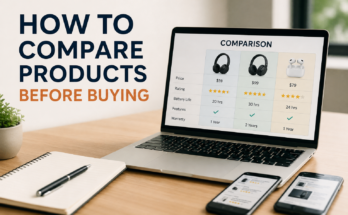
I rarely choose the first product I find. Instead, I usually compare several similar products.
Comparison helps me understand whether a product actually offers good value. Sometimes a slightly cheaper product provides almost everything I need. In other situations, paying more may provide meaningful improvements in quality, reliability, or features.
When comparing products, I focus on the features that matter to me instead of simply counting how many features each product has.
A product with twenty features is not necessarily better than one with ten useful features.
Consider the Price Carefully
Price is another important part of reliable product research. I do not automatically assume that the most expensive product is the best.
A high price may be justified by better materials, stronger performance, longer durability, better support, or additional features. However, sometimes I may simply be paying for a brand name or features that I will never use.
I like to compare the product’s price with its actual benefits. I also check whether similar products offer comparable quality at a lower price.
Thinking about value instead of price alone helps me make more practical buying decisions.
Check Product Specifications
I also recommend checking the manufacturer’s specifications before buying a product.
Reviews are useful for understanding real world experiences, but official specifications can confirm important technical details.
Depending on the product, I might check dimensions, battery capacity, storage, compatibility, materials, warranty information, power requirements, or other relevant specifications.
I never assume that a product is compatible with my existing devices simply because a review says it worked for someone else. I verify important details myself.
Look for Long Term Experiences
Short term reviews can tell me how a product feels when it is new. Long term experiences can tell me much more about durability and reliability.
Whenever possible, I look for people who have used a product for several months or longer.
Long term users may mention battery degradation, software problems, physical wear, customer support experiences, or other issues that may not appear during the first few days.
This is particularly important when I am buying something expensive or something I expect to use for several years.
Be Careful With Sponsored Recommendations
Sponsored content can be useful, but I treat it differently from independent reviews.
A sponsored article or video may provide helpful information, but I remember that the creator may have received compensation for promoting the product.
I do not automatically reject sponsored content. Instead, I look for transparency and balanced information. If the recommendation clearly explains both advantages and disadvantages, it can still help me understand the product.
The important thing is to recognize the difference between advertising and independent evaluation.
Use Customer Questions and Answers
Many online stores include questions and answers from customers. I find these sections useful because they often address practical issues that are not clearly explained in product descriptions.
Customers may ask whether a product works with a particular device, whether it is suitable for a specific purpose, or whether certain accessories are included.
These answers should not always be treated as official information, but they can provide useful clues. When something is important, I verify it through the manufacturer’s documentation.
Consider the Return Policy and Warranty
A reliable product recommendation should not focus only on the product itself. I also consider what happens if something goes wrong.
Before buying, I check the return policy, warranty coverage, repair options, and customer support.
This becomes especially important for expensive electronics and other products that may be difficult or costly to replace.
A slightly more expensive product from a seller with good customer support may provide better overall value than a cheaper product with poor support.
Watch for Fake or Manipulated Reviews
I also try to remain cautious about suspicious reviews. Not every review online is genuine.
If a product has many reviews that use almost identical language, provide very little detail, or appear unusually enthusiastic, I do not rely heavily on them.
I look for detailed experiences from people who explain how they used the product and what they liked or disliked.
A mixture of positive, neutral, and negative opinions often feels more realistic to me than a page filled with perfect praise.
Do Not Let Trends Make the Decision
Popular products are not always the right products for everyone.
Social media can make certain products appear essential because they are trending. Influencers and viral videos can also create the impression that everyone needs a particular product.
I try to step back and ask myself whether the product actually solves a problem for me.
If I cannot explain why I need it, I usually reconsider the purchase.
Make the Final Decision Based on Your Priorities
After researching everything, I make my decision based on my own priorities.
I consider quality, price, reliability, features, reviews, warranty, and long term value. I do not expect to find a perfect product because almost every product has some limitations.
Instead, I look for the product whose strengths match my needs and whose weaknesses I can accept.
This mindset makes product research much easier because I am no longer searching for a product that everyone says is perfect. I am searching for a product that is right for me.
Final Thoughts
Finding reliable product recommendations requires a little patience, but I believe the extra research is worth it. Online shopping has made it easier than ever to compare products, but it has also made it easier to become overwhelmed by advertisements, sponsored content, exaggerated claims, and unreliable reviews.
My approach is simple. I first understand what I need, then compare several products and research them through different sources. I read both positive and negative reviews, check specifications, consider long term experiences, investigate the seller, and think carefully about the overall value.
Most importantly, I do not allow someone else’s recommendation to completely replace my own judgment.
A reliable recommendation should help me make a better decision, not make the decision for me. When I combine trustworthy information with my own needs and budget, I have a much better chance of choosing a product that I will actually be happy with for the long term.