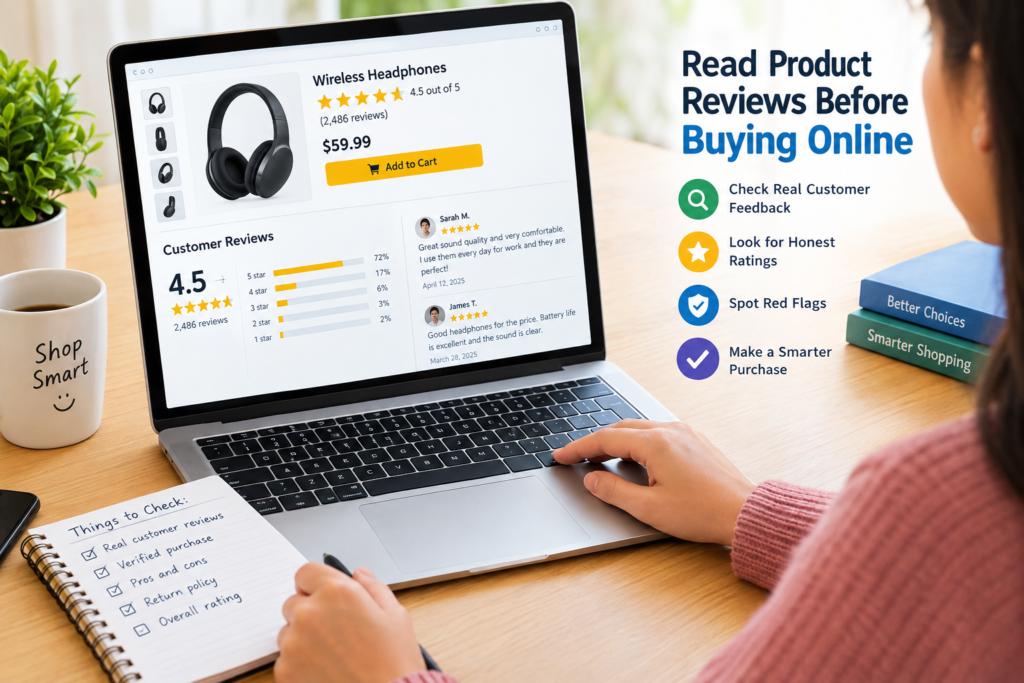
Shopping online has become one of the easiest ways to find products, compare prices, and buy things from home. I personally like online shopping because it saves time and gives me access to many choices. However, I have also learned that looking only at the product pictures, price, or star rating is not enough. Before buying something online, I believe one of the most useful things we can do is read product reviews carefully.
Product reviews can tell us what a product is actually like after someone has used it. A product description may explain features and specifications, but customer reviews often provide practical information that is difficult to find elsewhere. They can help us understand product quality, durability, size, performance, packaging, delivery experience, and possible problems.
In my experience, learning how to read product reviews before buying online can help reduce unnecessary spending and make online shopping much safer and smarter.
Why Product Reviews Matter Before Online Shopping
When I visit an online store, I usually see attractive product pictures and a detailed description. Everything may look perfect. But a product can sometimes look better online than it actually feels when it arrives.
This is where customer reviews become valuable.
Reviews are written by people who have purchased or used the product. Their experiences can provide additional information about the product that the seller may not mention. For example, a pair of shoes may look comfortable in pictures, but customers may explain that the shoes run smaller than expected.
Similarly, an electronic product may have excellent specifications, but reviews may reveal problems with battery life or durability.
I do not consider every review to be completely accurate. Instead, I look for patterns. If many customers mention the same issue, I pay more attention to it.
Start With the Overall Star Rating
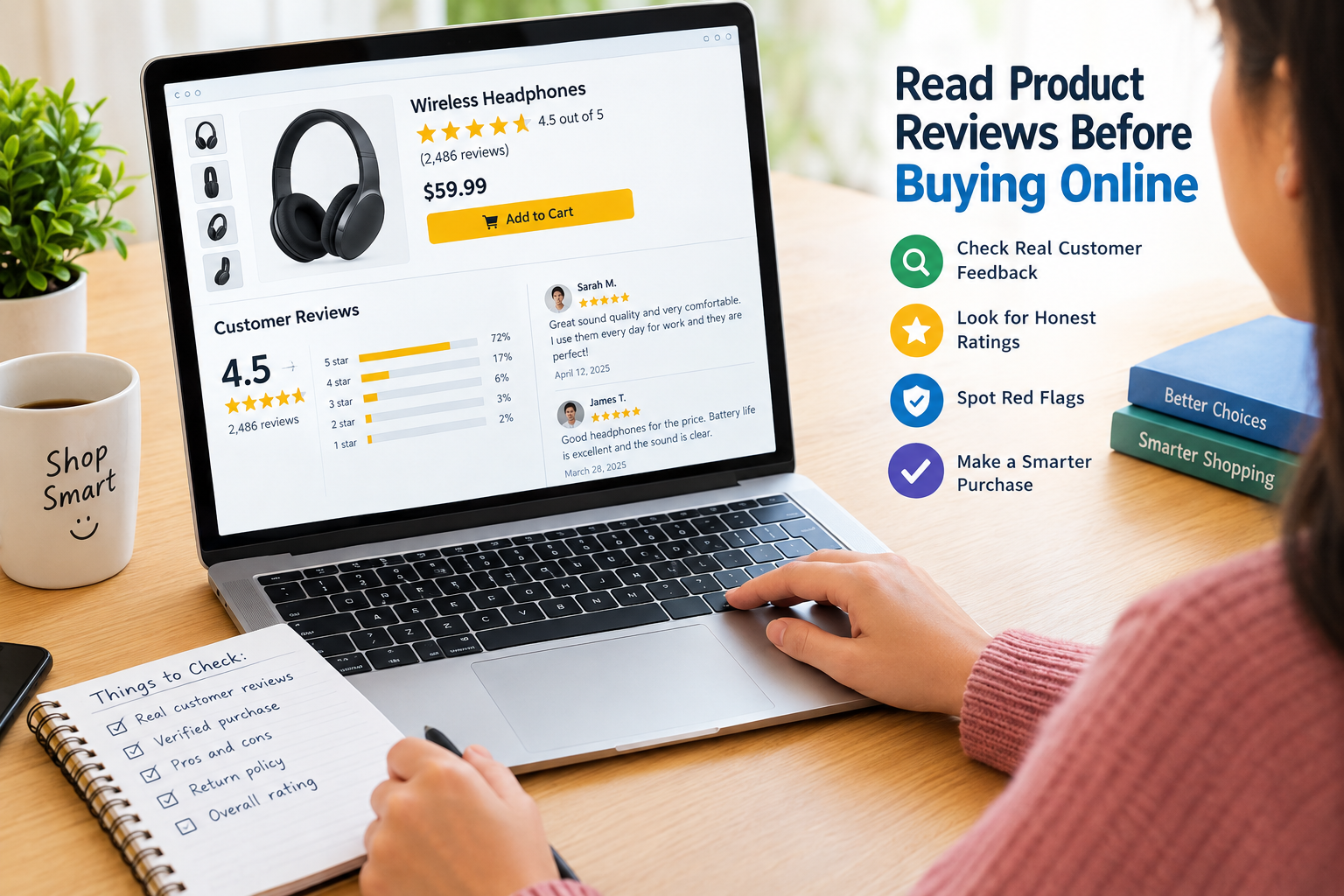
The first thing I normally check is the overall star rating. It gives me a quick idea about how customers generally feel about the product.
However, I do not make my buying decision based only on the star rating.
A product with a 4.8 star rating may look excellent, but I still want to know why customers gave those ratings. Sometimes a product receives many positive ratings because it is inexpensive, while customers may still mention certain limitations.
I also look at the number of reviews. A 5 star rating based on ten reviews does not provide the same level of information as a 4.5 star rating based on thousands of reviews.
For me, the combination of rating, number of reviews, and written feedback is much more useful than the star rating alone.
Read Both Positive and Negative Reviews
One of the biggest mistakes I see people make is reading only five star reviews.
Positive reviews are useful because they explain what customers like about a product. They may mention good quality, useful features, attractive design, comfortable use, or good value for money.
But negative reviews are equally important.
I usually read some one star, two star, three star, and five star reviews. This gives me a more balanced picture of the product.
For example, if most customers say a product works well but several customers complain about complicated instructions, that may not be a serious problem for me.
On the other hand, if many customers report that the product stopped working after a few weeks, I would think carefully before purchasing it.
The purpose is not to find a product with zero negative reviews. Almost every product has some unhappy customers. The goal is to understand whether the common complaints matter to me.
Look for Detailed Customer Reviews
Short reviews such as “Good product” or “Very nice” do not tell me much.
I prefer detailed reviews that explain how the product was used and what the customer experienced.
For example, a review saying, “I used this backpack for a two week trip and the zipper, straps, and storage compartments worked well” is much more useful than simply saying, “Excellent.”
Detailed reviews can help me understand how the product performs in real situations.
When reading product reviews, I look for comments about quality, performance, comfort, durability, size, material, ease of use, and value for money.
These details help me decide whether the product is suitable for my specific needs.
Check Verified Purchase Reviews
If an online store identifies a review as coming from a verified purchase, I usually give it more attention.
A verified purchase label generally indicates that the reviewer bought the product through that platform. This does not automatically mean that the review is perfect or completely unbiased, but it can provide additional context.
I still read the actual content of the review because a verified review can also be very short or vague.
The important thing is to combine the verified purchase information with detailed customer experiences and review patterns.
Pay Attention to Recent Reviews
Products can change over time.
A manufacturer may update a product, change materials, modify packaging, or release a new version. Because of this, I like to read some of the most recent product reviews.
Older reviews can still be helpful, especially when learning about long term durability, but recent reviews may provide a better idea of the product customers are currently receiving.
If an older review says the product had excellent quality but several recent reviews mention declining quality, I would investigate further before purchasing.
This is one reason I never rely on a single review.
Look for Common Problems
While reading customer feedback, I try to identify repeated complaints.
One negative review does not necessarily mean there is a major problem. People can have unusual experiences, misunderstand instructions, or simply have different expectations.
However, if dozens of customers mention the same problem, I consider it a warning sign.
Common complaints might involve poor battery life, inaccurate sizing, weak materials, missing parts, difficult setup, poor packaging, or slow performance.
The more frequently an issue appears, the more seriously I take it.
Compare Reviews With Your Own Needs
A product can have thousands of positive reviews and still be wrong for me.
This is an important point I have learned from online shopping.
For example, customers may love a particular laptop because it is lightweight. But if I need a powerful computer for demanding software, lightweight design may not be my main priority.
Similarly, many people may love a small kitchen appliance because it takes little space. If I need to prepare large family meals, that same product may not be suitable.
Before reading reviews, I try to understand what I actually need. Then I read reviews with those requirements in mind.
This makes the process much more useful.
Be Careful With Extremely Short Reviews
I do not completely ignore short reviews, but I do not depend on them.
A review that simply says “Amazing,” “Bad,” or “Worth it” provides very little information.
I prefer reviews that explain why the person liked or disliked the product.
Sometimes hundreds of very short reviews can make a product appear extremely popular, but they may not provide enough information to make a confident decision.
I therefore focus more on useful details than on the number of comments alone.
Check Customer Photos When Available
Customer photos can be extremely useful when shopping online.
A professional product photograph shows the item under controlled conditions. Customer photos may show what the product looks like in a normal home or everyday environment.
For clothing, customer photos can help me understand the actual color, fit, and appearance.
For furniture, they may show the real size and finish.
For electronics and accessories, customer photos can help confirm the design and included components.
I find customer photos particularly useful when the product’s appearance or size is important to my decision.
Watch for Reviews That Sound Unnatural
I also pay attention to reviews that sound overly promotional or repetitive.
If many reviews use almost identical wording, provide no useful details, or seem unusually enthusiastic without explaining why, I become more cautious.
I do not automatically assume that such reviews are fake because there can be many reasons for similar wording. However, I prefer genuine sounding feedback that describes a specific experience.
A useful review usually explains what the customer bought, ho